
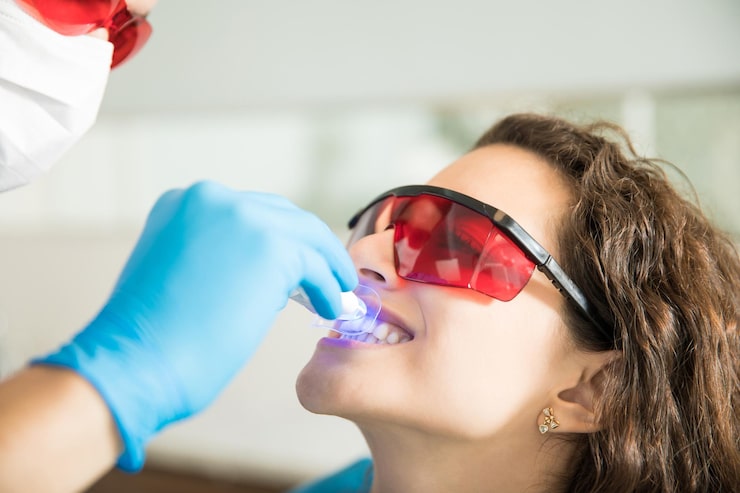
Look for a dentist who examines your teeth and gums before whitening anything, explains which method they use and why, tells you plainly what sensitivity to expect, points out which of your teeth will not lighten, and gives you the cost in writing. Those five things separate a considered laser whitening treatment from a product being sold to you.
This guide covers what laser whitening actually involves, what the evidence says about the laser part specifically, what results are realistic, and how to tell whether a practice is giving you a straight answer.
Quick Answer
Choose a dentist who assesses your oral health first, since decay, gum disease, or exposed roots change whether whitening is advisable. They should explain the whitening process in plain terms, discuss the likelihood of tooth sensitivity, identify any crowns, veneers, or fillings that will not change color, and give transparent cost information. A consultation determines whether professional whitening suits your teeth.
What Is Laser Teeth Whitening?
Professional whitening uses a peroxide-based bleaching gel to lighten certain kinds of tooth discoloration. The gel breaks down stain molecules within the tooth structure, and that is the part doing the actual work.
Some in-office systems add a light or laser while the gel is in place, on the theory that it accelerates the reaction. Practices use different systems, and what is marketed as laser whitening may involve an LED lamp, a dental laser, or no light at all.
Two things worth knowing from the start. Not all professional whitening uses a laser, and plenty of effective in-office whitening involves no light at all. The laser is also not automatically the part producing the result, as the next sections explain. Our page on teeth whitening in Waltham covers the options available.
How to Find the Best Dentist for Laser Teeth Whitening in Waltham, MA
The things worth comparing are not the ones that appear in advertising. Look for these:
✓ They examine your teeth and gums before agreeing to whiten anything
✓ They explain which whitening method they use, and what the light or laser is actually contributing
✓ They raise tooth sensitivity and gum irritation before you ask about them
✓ They tell you which existing crowns, veneers, or fillings will not change color
✓ They give you the cost in writing, including any preliminary treatment needed first
✓ They discuss alternatives when whitening is unlikely to achieve what you want
✓ They answer questions without steering you toward the most expensive option
A dentist who tells you whitening will not fix your particular discoloration is more useful than one who sells you a laser whitening treatment regardless. That willingness to say no is the clearest signal you will get. See our guide to professional teeth whitening in Waltham for what treatment involves.
Does Laser Teeth Whitening Actually Work?
Professional whitening does lighten many kinds of natural discoloration, particularly surface staining from coffee, tea, red wine, and tobacco. How much depends on your starting shade, the cause, the strength of the agent, and how treatment is delivered.
The laser part deserves a more careful answer than it usually gets. A systematic review and meta-analysis comparing in-office bleaching with and without light found that at the high hydrogen peroxide concentrations typically used in-office, around 25 to 35 percent, adding light made no detectable difference to the whitening result. At lower concentrations, around 15 to 20 percent, light did improve the immediate effect. The same review found light activation was associated with a significantly higher rate of tooth sensitivity during treatment.
Practically: the gel does most of the work, and a dentist who says so is being straight with you. Ask which concentration their system uses and what the light contributes in your case. Our article on does laser teeth whitening work covers this further.
One firm limitation regardless of method: crowns, veneers, fillings, and bonding do not lighten the way natural enamel does. If you have visible restorations, whitening the teeth around them can make them stand out more, not less.
What Happens During a Professional Whitening Appointment?
Protocols vary between systems and practices, but the general sequence is consistent.
Your dentist assesses your oral health and the type of discoloration, checking for decay, gum disease, recession, and existing restorations, then explains the proposed method and what results are realistic for your teeth.
Before the gel goes on, the gums and soft tissues are protected, usually with a barrier applied along the gumline, because the whitening agent irritates soft tissue on contact. The gel is then applied according to the system’s instructions, sometimes in more than one application during the same visit, with or without light depending on the product.
Afterward the dentist reviews the result and gives aftercare guidance, usually including avoiding strongly staining foods and drinks for a period while the teeth are more porous. Appointment length depends on the system and how many applications your case needs.
Benefits and Downsides of Laser Teeth Whitening
Potential benefits. Treatment is supervised by a dentist who has examined your mouth first, which matters because whitening over untreated decay or gum disease is a bad idea. The plan is built around your dental condition rather than a one-size product, professional-strength agents reach discoloration that over-the-counter products do not, and you get guidance on maintaining the result.
Possible downsides. Tooth sensitivity is common during and after treatment, and the evidence indicates light-activated systems carry a higher rate of it. Gum irritation can occur if the material contacts soft tissue. Results can look uneven across teeth with different discoloration, crowns and veneers and fillings will not lighten, and professional treatment costs more than at-home options.
Whitening is not risk-free and it does not suit every patient. If sensitivity is already an issue for you, raise it before treatment rather than during it. Our guide to safe, long-lasting teeth whitening covers managing sensitivity in more detail.
How Long Do Whitening Results Last?
Results vary considerably between individuals, and we are not going to quote a number of months. What determines it is mostly what happens after treatment.
Coffee, tea, red wine, dark sodas, and tobacco all reintroduce staining, and frequency matters more than quantity. Oral hygiene plays a large part, since stain accumulates faster on teeth that are not cleaned thoroughly, and natural age-related color change continues regardless.
Maintenance needs differ by system and by habits. Some patients do well with periodic touch-up trays, others need nothing beyond good hygiene and regular cleanings. Ask what suits your case, and resist whitening repeatedly beyond what is recommended, since overuse increases sensitivity without improving the result.
How Much Does Laser Teeth Whitening Cost in Waltham?
Cost depends on the system used, the practice, how many applications your case needs, and whether preliminary treatment is required first. A patient needing a cleaning or filling before whitening is not comparable to one ready to proceed. We are not publishing a local figure, because a number quoted in an article is not an estimate.
On insurance: cosmetic whitening is generally not covered, since dental plans typically exclude treatment undertaken purely for appearance. Coverage depends on your specific plan and circumstances, so confirm it rather than assume either way. Ask for a clear written estimate before treatment, and see our page on professional teeth whitening cost in Waltham for what the estimate should include.
Can Older Adults Get Laser Teeth Whitening?
Age by itself does not rule out professional whitening. What matters is the condition of the teeth and gums, which does tend to change over time.
Your dentist will check for gum recession and exposed root surfaces, since roots are not covered by enamel, whiten differently, and are more prone to sensitivity. They will also look at existing restorations, often more numerous, and any decay needing treatment first.
The discoloration itself differs too. Teeth darken with age partly because the dentine beneath the enamel becomes more visible, and that internal change responds less predictably than surface staining. Whitening may still help, but discuss what is realistic first.
Which Teeth Cannot Be Whitened Effectively?
Not all discoloration responds the same way, and knowing which category yours falls into saves disappointment.
Surface staining from food, drink, and tobacco generally responds well. Internal discoloration behaves differently: staining from within the tooth, certain developmental conditions, and darkening following injury or root canal treatment may respond partly, slowly, or not at all, and sometimes needs a different approach entirely.
Restorations are the clearest limitation. Crowns, veneers, fillings, and bonding do not lighten with whitening gel. If they are visible when you smile, whitening the surrounding teeth can increase the mismatch, and replacing the restorations afterward to match may be the only way to even things out.
A dentist can tell you which applies to your teeth, and whether whitening or another option makes more sense.
How to Maintain Your Whitening Results
✓ Brush twice daily for two minutes with fluoride toothpaste
✓ Clean between your teeth daily, where surface stain accumulates unseen
✓ Keep up with routine dental examinations and cleanings as recommended
✓ Limit frequent exposure to coffee, tea, red wine, and dark sodas where practical, and rinse with water afterward
✓ Avoid tobacco products, which stain quickly and affect gum health
✓ Follow your dentist’s instructions for any recommended touch-up whitening
A note on do-it-yourself approaches: abrasive and acidic home remedies such as lemon juice, undiluted vinegar, or frequent scrubbing with baking soda can wear enamel, and enamel does not grow back. Ask your dentist before adopting anything you read about online.
Book a Teeth Whitening Consultation in Waltham, MA
An evaluation before whitening is not a formality. It determines whether your teeth and gums can whiten safely, which type of discoloration you have, and what result is realistic.
Before deciding, you should understand the method being proposed, what the expected result is, the limitations including any restorations that will not change, and the full cost. If you are considering laser whitening treatment in Waltham, MA, contact Smiley Dental Waltham to discuss your whitening goals and whether professional treatment suits your teeth.
Frequently Asked Questions
How much does it cost to laser whiten your teeth?
It depends on the system used, the practice, how many applications your case needs, and whether any preliminary treatment is required first. We are not quoting a figure, since a published average rarely matches a real estimate. Cosmetic whitening is generally not covered by dental insurance. Ask for a written estimate after your consultation.
Does smile teeth whitening actually work?
Professional whitening does lighten many kinds of natural discoloration, particularly surface staining from food, drink, and tobacco. How much depends on your starting shade and the cause. Internal discoloration responds less predictably, and crowns, veneers, and fillings do not lighten at all.
What are the downsides of laser teeth whitening?
Tooth sensitivity is the most common, and research indicates light-activated systems carry a higher rate of it than gel alone. Gum irritation can occur if the material contacts soft tissue. Results can look uneven across teeth with different discoloration, restorations will not match, and professional treatment costs more than at-home options.
How long do teeth stay white after laser whitening?
It varies widely and depends mostly on what happens afterward. Coffee, tea, red wine, dark sodas, and tobacco reintroduce staining, and how often you consume them matters more than how much. Good oral hygiene and regular cleanings extend the result. We are not quoting a duration, since that would be a guess about your habits.
How long will laser whitening last?
The same factors apply: diet, smoking, how thoroughly you clean your teeth, and natural age-related color change. Some patients maintain the result with hygiene alone, others use periodic touch-ups. Ask what maintenance suits your case rather than planning around a fixed timeframe.
What is the cheapest way to whiten my teeth naturally?
The least expensive approach that is actually safe is reducing staining habits, brushing properly twice daily, cleaning between teeth, and having a professional cleaning, which removes surface stain and tartar. Be cautious with popular home remedies. Lemon juice and vinegar are acidic, and frequent abrasive scrubbing with baking soda or charcoal can wear enamel permanently.
Can 60 year old teeth be whitened?
Often yes, since age alone does not rule it out. What matters is the condition of your teeth and gums, so your dentist will check for recession, exposed roots, sensitivity, decay, and restorations. Age-related darkening comes partly from the dentine beneath the enamel, which responds less predictably.
What does Kim Kardashian use to whiten her teeth?
No one outside a public figure’s dental team can verify what treatment they have had, so treat any claim you read with scepticism. Worth knowing more generally: the very uniform, very white celebrity smile is usually porcelain veneers and other cosmetic dentistry rather than whitening alone. Whitening lightens your own teeth; it does not reproduce someone else’s.
Do teeth turn yellow again after whitening?
Gradually, yes. Whitening is not permanent, and teeth pick up new staining from food, drink, and tobacco while continuing to change naturally with age. How quickly depends on your habits and hygiene. Regular cleanings and the maintenance your dentist recommends slow it down.
Which teeth cannot be whitened?
Crowns, veneers, fillings, and bonding do not lighten with whitening gel, because they are not natural enamel. Teeth with internal discoloration, including some darkened after injury or root canal treatment, respond partly or not at all. A dentist can identify which of yours fall into these categories before you commit to treatment.
Choosing on Substance Rather Than Price
Selecting a dentist for laser teeth whitening involves more than comparing prices. What you want to understand before agreeing to anything is the method being used, how likely sensitivity is, what result is realistic for your particular discoloration, which teeth will not change, and what maintenance follows.
A practice that walks you through all five, including the parts that are not good news, is giving you what you need to decide. Arrange an evaluation and ask the questions in this article. The answers will tell you a great deal about where to have the treatment done.