
QUICK ANSWER
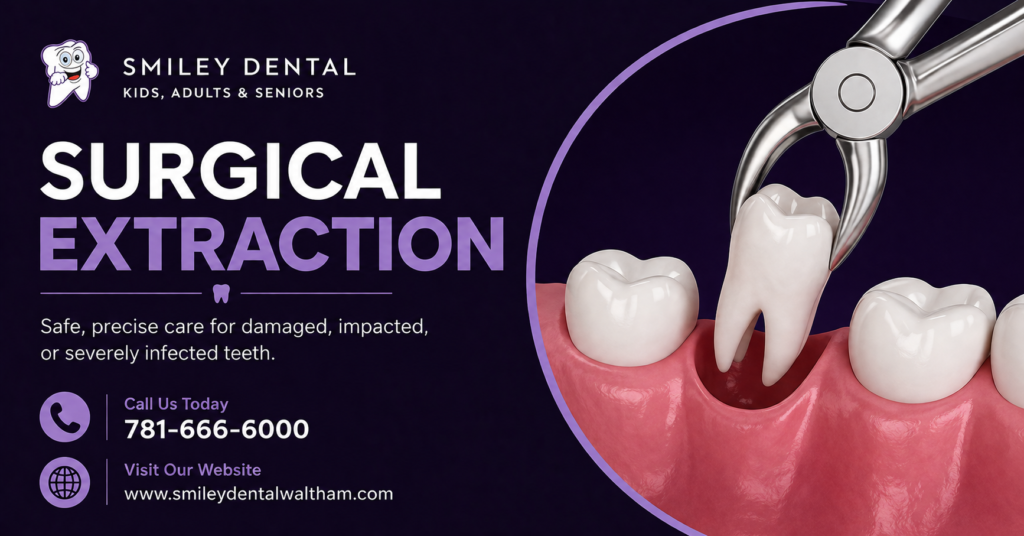
A surgical extraction removes a tooth that cannot be lifted out easily, such as one that is impacted, broken below the gumline, or has curved roots. The dentist numbs the area, makes a small gum incision, and removes the tooth, sometimes in sections. Most people feel better within 2 to 3 days.
Nobody looks forward to having a tooth pulled. Yet when a tooth is badly broken, infected, or stuck beneath the gum, removing it is often the kindest thing you can do for the rest of your mouth.
The good news is that a surgical extraction today is nothing like the ordeal people imagine. With modern anesthesia, 3D imaging, and careful technique, the procedure is precise, comfortable, and usually over in well under an hour. Here is exactly what to expect, from the first numbing injection to the day you forget it ever happened.
In This Article
- What Is a Surgical Extraction?
- When Is Surgical Tooth Removal Necessary?
- The Oral Extraction Surgery Procedure, Step by Step
- Recovery: What to Expect Day by Day
- How Much Does a Surgical Extraction Cost?
- What Comes Next: Replacing the Tooth
- Preventing the Next Extraction
- Why Choose Smiley Dental Waltham
- Complete Your Smile: Related Treatments
- The Bottom Line
What Is a Surgical Extraction?
A surgical extraction is the removal of a tooth that cannot be taken out with simple instruments alone. Your dentist makes a small opening in the gum to reach the tooth, and may remove a little bone or divide the tooth into pieces so it lifts out cleanly and safely. You can read more about how we handle simple and surgical extractions at our Waltham office.
Sectioning a tooth sounds dramatic, but it is actually the gentler approach. Taking a tooth out in smaller pieces means less pressure on the surrounding bone and gum, which usually leads to a smoother recovery.
Simple vs Surgical Extractions
Not every tooth needs surgery. Here is how the two approaches compare.
| Simple Extraction | Surgical Extraction | |
|---|---|---|
| The tooth | Fully erupted and easy to reach | Impacted, broken, or below the gumline |
| Technique | Loosened and lifted with instruments | Small gum incision, sometimes sectioned |
| Anesthesia | Local numbing | Local numbing, sedation optional |
| Typical time | About 20 minutes | 20 to 45 minutes |
| Recovery | A day or two | 2 to 3 days for routine, weeks for bone |
When Is Surgical Tooth Removal Necessary?
Dentists always try to save a natural tooth first. Surgical dental extractions are recommended when saving it is no longer realistic or safe. Common reasons include:
- Impacted teeth. Wisdom teeth trapped under gum or bone are the most common case.
- Severe fracture. A tooth broken at or below the gumline cannot be gripped normally.
- Advanced decay or infection. When decay destroys too much structure to restore.
- Severe gum disease. Bone loss can leave a tooth loose and unsalvageable.
- Crowding. Occasionally a tooth is removed to create room before orthodontic treatment.
Before recommending removal, we always check whether the tooth can be rescued. A deeply infected tooth can often be saved with root canal treatment and a crown instead. Extraction is the last resort, not the first.
When It Cannot Wait
Some situations call for emergency surgical tooth extraction. Severe swelling, throbbing pain that keeps you awake, a fractured tooth after an accident, or signs of spreading infection all need prompt attention. Do not wait it out. Our same day emergency care gets you seen quickly, because an untreated dental infection can spread beyond the mouth.
In pain right now?
Do not tough it out. Call Smiley Dental Waltham at 781-666-6000 or request an appointment online. Same-day visits are available.
The Oral Extraction Surgery Procedure, Step by Step
Knowing the sequence takes most of the fear out of it. Here is how a typical oral extraction surgery unfolds:
- Exam and imaging. An X-ray or 3D scan shows the roots and their position relative to nerves and sinuses.
- Numbing. Local anesthesia fully numbs the tooth and surrounding tissue. Sedation is available if you feel anxious.
- Access. A small incision opens the gum so the dentist can see the tooth clearly.
- Removal. The tooth is loosened and lifted out, sometimes divided into sections to protect the bone.
- Cleaning and closing. The socket is cleaned, a bone graft may be placed, and stitches close the site.
- Gauze and instructions. You bite on gauze to control bleeding and leave with clear aftercare guidance.
You should feel pressure but no pain. If you feel anything sharp, say so, and more anesthetic is added straight away.
Recovery: What to Expect Day by Day
Healing follows a predictable pattern. Most people are back to their normal routine within 2 to 3 days, though the jawbone continues to fill in for several weeks.
| Timeframe | What to Expect | What to Do |
|---|---|---|
| First 24 hours | Some bleeding and oozing | Bite on gauze about 30 minutes, use cold packs, rest |
| Days 2 to 3 | Swelling peaks, then eases | Soft foods, keep resting, take medication as directed |
| Days 4 to 7 | Discomfort fades noticeably | Gentle warm salt water rinses, return to light routine |
| Week 2 | Gum surface largely healed | Resume normal brushing around the site |
| Weeks to months | Bone quietly fills the socket | Attend follow-ups, discuss replacing the tooth |
Aftercare That Protects Your Healing
- Change the gauze when it becomes soaked. Light bleeding for 24 to 48 hours is normal.
- Skip strenuous exercise for 2 to 3 days, since raised blood pressure can restart bleeding.
- Stick to soft foods such as yogurt, pasta, and eggs. Avoid hard or crunchy foods.
- Do not smoke, and do not use straws, as suction can dislodge the healing clot.
- Take prescribed medication as directed once the numbness wears off.
Expert Dental Tip
The blood clot in the socket is doing all the work. Dislodging it causes dry socket, which is genuinely painful and delays healing. For a full week, no straws, no smoking, and no vigorous rinsing or spitting. Let warm salt water simply fall out of your mouth instead.
How Much Does a Surgical Extraction Cost?
Price depends on how the tooth sits in the bone. Deeper impaction means more surgical time. These are typical 2026 per-tooth ranges in the United States.
| Type of Extraction | Typical Cost Per Tooth | Notes |
|---|---|---|
| Simple extraction | $150 to $350 | Fully erupted, easy to reach |
| Surgical extraction (erupted tooth) | $250 to $600 | Gum opened or tooth sectioned |
| Soft tissue impaction | $250 to $450 | Tooth covered by gum only |
| Partial bony impaction | $350 to $650 | Part of tooth embedded in bone |
| Full bony impaction | $400 to $800 or more | Tooth fully enclosed in bone |
Figures are 2026 national estimates drawn from ADA CDT fee data and published provider pricing. Nitrous oxide typically adds $50 to $150, and IV sedation $250 to $500 or more. Your exact quote is confirmed at your visit.
Insurance and Payment
Most dental plans treat surgical extractions as a major procedure and cover 50 to 80 percent of the allowed amount once your deductible is met, up to an annual maximum. We gladly handle claims for most major providers and are in-network with numerous PPO plans and MassHealth. If you would rather spread the cost, ask about our patient financing options.
What Comes Next: Replacing the Tooth
Once the socket heals, the gap deserves attention. Leaving it empty allows the jawbone to shrink and lets neighboring teeth drift out of line. The most durable replacement is a dental implant, a titanium post placed into the jaw and topped with a crown. Many patients ask about surgical dental implants at the same appointment as their extraction, and in suitable cases the implant can be placed right away.
If an implant is not the right fit, dental crowns and bridges offer a reliable alternative that restores your bite and keeps your smile even.
Preventing the Next Extraction
Most extractions trace back to decay or gum disease, and both are largely preventable. A few steady habits go a long way:
- Brush twice daily and clean between your teeth every day.
- Cut back on sugary drinks and frequent snacking.
- Wear a mouthguard for contact sports to avoid fractures.
- Never use your teeth to open packaging or crunch ice.
The American Dental Association recommends adults visit the dentist at least twice a year. Routine preventive dental care catches decay and gum disease early, while treatment is still simple and far less expensive than surgery.
Why Choose Smiley Dental Waltham
Precise extractions come from training and planning. Our team includes dentists with advanced surgical and implant credentials, including an oral and maxillofacial surgery internship completed at Massachusetts General Hospital and Harvard, an ICOI implant fellowship, and surgical implantology education from UCLA. Every complex case is mapped with 3D imaging so we know exactly where the roots, nerves, and sinuses sit before we begin.
We have been recognized among America’s Best dentists in recent years. Our multilingual team offers evening and weekend hours, and we serve patients across Greater Boston, including Waltham, Weston, Newton, Watertown, Lexington, Wayland, and Lincoln.
Complete Your Smile: Related Treatments
Once your mouth has healed, we can help you polish the result. Ask us about teeth whitening, Invisalign clear braces, and porcelain veneers to complete your care.
The Bottom Line
A surgical extraction is a routine, well-established procedure that ends pain, stops infection from spreading, and protects the teeth around it. With careful planning, good anesthesia, and sensible aftercare, most patients find the experience far easier than they expected and are back to normal within a few days.
If a tooth is aching, cracked, or your dentist has mentioned removal, the worst thing you can do is wait. Early treatment keeps your options open and your recovery simple.
Need a tooth looked at?
Book a consultation with Smiley Dental Waltham. Call 781-666-6000, request an appointment, or contact our Waltham office at 1030 Main St. Same-day visits are available, and new patients are always welcome.
Frequently Asked Questions
Everything you need to know about tooth-colored fillings.