
QUICK ANSWER
An emergency surgical tooth extraction removes a badly infected or broken tooth that cannot be lifted out simply. It works because it takes away the source of infection, which antibiotics alone cannot cure. Acting fast stops the infection spreading, protects the surrounding bone and teeth, and usually means a simpler recovery.
Most people wait. The tooth aches on Monday, they take some ibuprofen, and by Thursday the pain has settled a bit, so they decide it is sorting itself out.
That is the moment worth understanding, because a tooth infection settling down is not the same as a tooth infection going away. This article explains why an infected tooth cannot heal on its own, what removing it actually achieves, and why the timing matters more than almost anything else in dentistry.
In This Article
- What Is an Emergency Surgical Tooth Extraction?
- Why an Infected Tooth Cannot Heal Itself
- Why Antibiotics Alone Are Not a Cure
- What Happens If You Wait
- How Fast Removal Protects the Rest of Your Mouth
- When the Tooth Can Be Saved Instead
- What the Appointment Involves
- What Does It Cost?
- Replacing the Tooth Afterward
- Preventing the Next One
- Why Choose Smiley Dental Waltham
- Frequently Asked Questions
- The Bottom Line
What Is an Emergency Surgical Tooth Extraction?
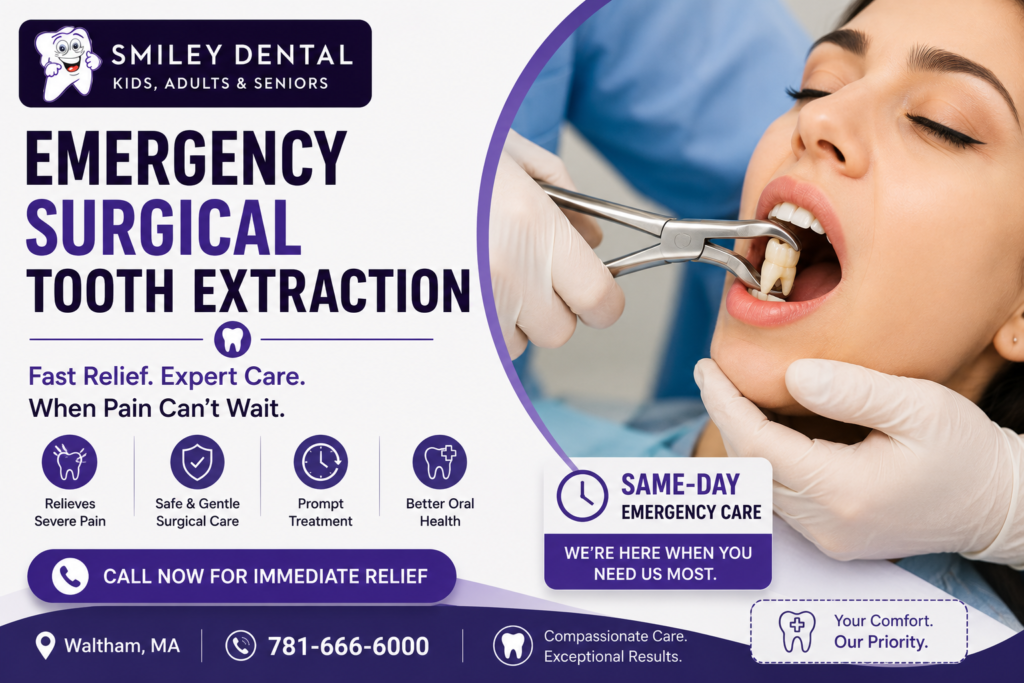
A surgical extraction removes a tooth that cannot simply be gripped and lifted out. Your dentist makes a small opening in the gum to reach it, and may divide it into sections so it comes away cleanly. It becomes an emergency when infection, severe pain, or trauma means it cannot wait for a routine appointment. You can read how we approach simple and surgical extractions at our Waltham office.
Surgical dental extractions sound more alarming than simple ones, but the surgical part usually makes the procedure gentler. Removing a tooth in pieces puts far less strain on the bone and gum around it, which is exactly what you want to preserve.
Why an Infected Tooth Cannot Heal Itself
This is the part that surprises people, and it is the key to the whole article.
Your immune system is remarkably good at clearing infection nearly everywhere in your body. It struggles inside a tooth. The pulp chamber has a very limited blood supply, and once bacteria establish themselves in there, your white blood cells simply cannot reach them in useful numbers. The bacteria are effectively behind a wall.
So the infection does not resolve. It waits, and it looks for a way out through the bone.
Why Antibiotics Alone Are Not a Cure
Antibiotics are genuinely useful for controlling the spread of an infection into surrounding tissue, and we prescribe them when they are needed. What they cannot do is sterilize the inside of a dead tooth, for the same reason your immune system cannot: the blood supply that carries the drug does not reach the source.
That is why antibiotics give real but temporary relief, and why the pain reliably comes back once the course finishes. The infection has a home, and it stays there until the source is dealt with. That means either treating the inside of the tooth or removing it.
It is also why pain fading on its own is not good news. If an abscess bursts and drains, the pressure drops and the pain eases considerably. The infection is still active. It has just found somewhere to go.
What Happens If You Wait
These complications are uncommon, and we are not trying to frighten you. They are worth knowing about precisely because they are so avoidable when a tooth is dealt with early.
| Timeframe | What Is Typically Happening |
|---|---|
| Days 1 to 3 | Pain and pressure build as the pulp dies and an abscess forms |
| Days 3 to 7 | Bacteria commonly spread from the pulp into the surrounding tissue and bone |
| 1 to 2 weeks | Systemic spread becomes possible, depending on your immune health |
| Any point | Swelling toward the airway or eye is an emergency, regardless of timeline |
Timelines are general clinical patterns, not a schedule. People who are immunocompromised, diabetic, or over 65 can develop complications considerably faster.
Where infection goes depends on which tooth is involved. An untreated lower molar is the usual origin of Ludwig’s angina, a rapidly spreading infection in the floor of the mouth that can push the tongue back and obstruct the airway. Upper teeth are a concern because the veins draining that area connect toward the sinuses at the base of the brain. Rarer still, infection can reach the jawbone, the heart lining, or the bloodstream.
Again: these outcomes are rare. Their rarity is precisely because most people get the tooth treated. That is the whole argument for not waiting.
Call 911 or go to the emergency room if you have
Difficulty breathing or swallowing, swelling spreading toward your eye or down your neck, a fever above 101F alongside facial swelling, neck stiffness, or drooling and trouble speaking. These need a hospital, not a dental appointment. And be aware that infection can spread into the soft tissues and cause swelling without much pain, so do not use pain as your only guide.
How Fast Removal Protects the Rest of Your Mouth
When a tooth is genuinely beyond saving, taking it out early does five specific things:
- It removes the source. This is the one that matters. No source, no ongoing infection, and no reliance on antibiotics that were never going to cure it.
- It protects the bone. A chronic abscess dissolves the bone around the root. The sooner it goes, the more bone you keep, which matters enormously if you want an implant later.
- It protects the neighbors. Infection and decay spread sideways. The tooth next door is often the second casualty of a tooth nobody dealt with.
- It ends the pain properly. Not muted for a week, but finished.
- It keeps the treatment simple. An early extraction is a routine appointment. A late one can mean drainage, IV antibiotics, and a hospital.
Tooth hurting right now?
Do not wait to see whether it settles. Call our emergency dental hotline at 781-666-6000 or request an appointment online. We offer same day emergency care.
When the Tooth Can Be Saved Instead
Here is the part a lot of articles about extraction leave out. Removing the tooth is not the only way to remove the source of infection, and it is not our first choice. Cleaning out the infected pulp achieves the same thing while keeping your natural tooth. That is what root canal treatment does, and for a tooth with enough healthy structure left, it is the better outcome.
A tooth usually only comes out when it is broken below the gumline, split, too decayed to restore, or loose from advanced gum disease. Our first question at an emergency visit is always whether we can keep it. If someone reaches for the forceps before asking that, get a second opinion.
What the Appointment Involves
Oral extraction surgery is more straightforward than most people expect:
- Exam and imaging. An X-ray or 3D scan shows the roots and their relationship to nerves and sinuses.
- Numbing. The area is fully numbed. Sedation is available if you are anxious.
- Removal. A small gum incision, then the tooth is lifted out, sometimes in sections.
- Cleaning and closing. The socket is cleaned, a bone graft may be placed, and stitches close the site.
- Aftercare. Gauze for 30 to 45 minutes, cold compress, and clear instructions.
You should feel pressure but never anything sharp. Most single-tooth cases finish in well under an hour, and most people are back to normal within 2 to 3 days. For the full step-by-step on the procedure and recovery, see our companion guide to surgical extraction care.
Expert Dental Tip
If a course of antibiotics settled your toothache, book the appointment anyway. This is the single most common reason people end up needing emergency surgery months later. The antibiotics controlled the spread, which is exactly what they are for, but they did not touch the source inside the tooth. The relief is a window to get treated, not a sign you have been cured.
What Does It Cost?
Price depends on how the tooth sits in the bone, since that determines the surgical time involved. Typical 2026 per-tooth figures:
| Type | Typical Cost | Notes |
|---|---|---|
| Simple extraction | $150 to $350 | Fully erupted and easy to reach |
| Surgical extraction (erupted) | $250 to $600 | Gum opened or tooth sectioned |
| Soft tissue impaction | $250 to $450 | Tooth covered by gum only |
| Partial bony impaction | $350 to $650 | Part of the tooth in bone |
| Full bony impaction | $400 to $800 or more | Tooth fully enclosed in bone |
Figures are 2026 national estimates drawn from ADA fee data and published provider pricing. Sedation and imaging are additional. You receive a written estimate before treatment begins.
Most plans treat surgical extractions as a major procedure and cover a share once your deductible is met. We file claims for most major providers, and flexible patient financing through CareCredit, Cherry and Sunbit spreads the cost. Worth noting: waiting rarely saves money. An early extraction is the cheapest version of this problem you will ever be offered.
Replacing the Tooth Afterward
Unless it was a wisdom tooth, the gap needs a plan. Left empty, the jawbone in that spot shrinks and neighboring teeth drift. The most durable replacement is an implant, a titanium post placed into the jaw and topped with a crown. Surgical dental implants have one of the highest success rates in dentistry, often above 95 percent.
If an implant is not right for you, crowns and bridges or a partial denture restore your bite. This is another reason speed helps: the more bone you preserve by acting early, the more replacement options stay open, and the less likely you are to need a bone graft first.
Preventing the Next One
Almost every emergency extraction we perform started as something small and quiet:
- Keep up with checkups. Decay found early is a filling, not a 2am problem.
- Take sensitivity seriously. A tooth that reacts to cold for weeks is telling you something.
- Never ignore a pimple on the gum. That is a draining abscess, even if it does not hurt.
- Wear a mouthguard for contact sports.
- Do not chew ice or popcorn kernels, and never open packaging with your teeth.
Routine preventive dental care is unglamorous and it is the reason most people never read an article like this one from personal need.
Why Choose Smiley Dental Waltham
Emergency surgery rewards experience and planning. Our Waltham team includes a dentist who completed an Oral and Maxillofacial Surgery internship at Massachusetts General Hospital and Harvard Medical School and has served as clinical faculty at Harvard School of Dental Medicine, a dentist with an ICOI Fellowship who is certified in surgically placing implants and prosthetic restorations, a colleague who completed Surgical Implantology at UCLA, and a dentist who earned honors in Oral Surgery and Periodontics. Complex cases are mapped with 3D imaging so we know exactly where the roots, nerves and sinuses are before we begin.
We have been recognized among America’s Best dentists in recent years. We run an emergency dental hotline, our multilingual team offers Saturday appointments, and we serve Waltham, Newton, Watertown, Belmont, Lexington, Weston, Wayland and Lincoln.
Frequently Asked Questions
Can antibiotics cure a tooth infection without an extraction?
No. Antibiotics control the spread of infection into surrounding tissue, which is genuinely important, but they cannot reach the bacteria inside the tooth because the blood supply there is so limited. The relief is temporary. The infection returns until the source is treated with either a root canal or an extraction.
My toothache stopped hurting. Do I still need to be seen?
Yes, and this is the most important question on this page. Pain stopping often means the nerve has died or an abscess has burst and drained. The pressure is relieved, so it feels better. The infection is still active and still spreading. Get it looked at.
Is an emergency surgical tooth extraction painful?
Not during the procedure. The area is fully numbed with local anesthetic, and sedation is available if you are anxious, so you feel pressure rather than pain. Afterward, soreness and swelling for a few days are normal and respond well to pain relief and a soft-food diet.
How long is recovery after surgical dental extractions?
Most people feel much better within 2 to 3 days and the gum surface heals over roughly two weeks. The bone underneath continues filling in for several weeks. Protect the blood clot: no straws, no smoking, and no forceful rinsing for the first week, or you risk dry socket.
Should I go to the ER or a dentist for a tooth infection?
Go to the ER for difficulty breathing or swallowing, spreading facial swelling, a fever above 101F with swelling, or neck stiffness. Otherwise a dentist is the right call. An ER can manage pain and start antibiotics, but they cannot treat the tooth, which is what actually resolves it.
How soon can I replace the tooth after an extraction?
Sometimes the same day, if there is enough healthy bone and no active infection. If there was significant infection, we usually let the site heal for a few months first, which gives the implant a much better foundation. We talk through the options at your visit.
The Bottom Line
An emergency surgical tooth extraction saves your oral health for one simple reason: it removes the source of an infection that your immune system cannot reach and antibiotics cannot cure. Everything else follows from that. The pain ends, the bone stops dissolving, the neighboring teeth are spared, and the treatment stays small.
The tooth is not really the emergency. The delay is. If something in your mouth is aching, swollen, or has quietly stopped hurting after weeks of trouble, that is worth a phone call today rather than a hospital visit next month.
Need to be seen today?
Call the Smiley Dental Waltham emergency hotline at 781-666-6000, request an appointment, or contact our Waltham office at 1030 Main St. Saturday appointments are available, and new patients are always welcome.
Frequently Asked Questions
Everything you need to know about emergency tooth extraction.